





Portable Music Players
1979 onwardsPortable music has been reinvented roughly once a decade, and each time the change was really about how much you could bring. One tape. One disc. Then everything.
One album at a time
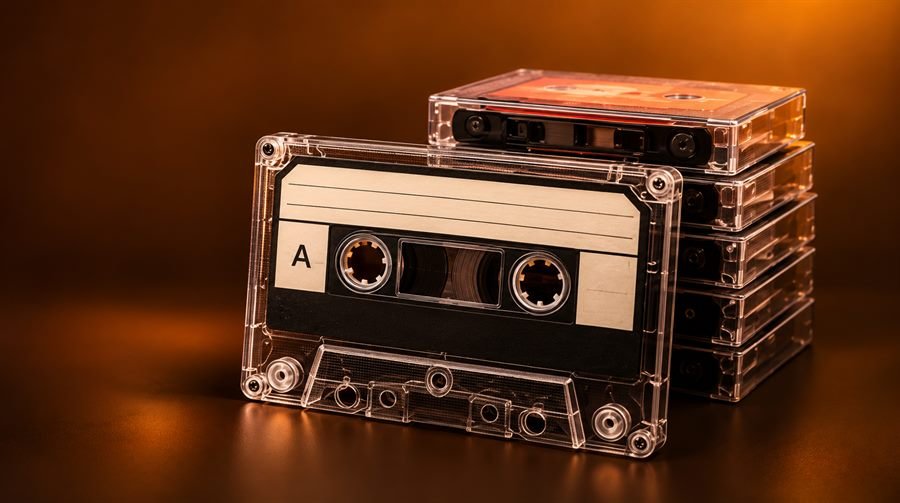
Sony launched the TPS-L2 in Japan on 1 July 1979, reaching the United States the following year. It played cassettes, ran on two AA batteries, and did not record — an omission that seemed strange until people used it.
You chose what to bring before leaving the house, and lived with that decision. The mixtape existed partly because of this constraint: if you could only carry ninety minutes, they had better be the right ninety minutes.
Portable CD players followed and brought better sound, but a spinning disc and walking are poor companions — skip-protection buffers existed entirely to paper over that.
Everything at once
Apple released the first iPod on 23 October 2001: a 5 GB hard drive holding roughly a thousand songs. The number mattered less than the shift it represented — you were no longer choosing what to bring.
Windows support arrived in 2002 and the iTunes Store in 2003, and the store may have been the more consequential half. Buying a single track legally in a few seconds gave people an alternative to file sharing that was simply easier than stealing.
What it changed
Listening became private and continuous. Music filled commutes, walks, gyms and queues — time that had previously been silent or shared.
It also changed the shape of a collection. Shelf space had always been the limit; now the limit was a number on a specification sheet, and shortly after that, nothing.
Then and now
The dedicated player was absorbed by the phone, which already had the screen, the storage and the network. Standalone players survive mainly for people who want high-resolution playback or a device that does not interrupt.
That last motivation is quietly growing. A player that cannot receive a notification is now a feature rather than a limitation.
Names that mattered
Listed because of what they did, not as recommendations. Velorex Music did not make any of these.
Did you know?
- The first iPod held about 1,000 songs on a 5 GB drive.
- The original Walkman had two headphone jacks — Sony expected listening to remain a shared activity.
- Portable CD players buffered audio into memory specifically so walking would not cause skipping.
- iTunes selling single tracks legally is widely credited with reducing casual file sharing more than enforcement did.
Remember this?
The universal memory is the battery. Working out whether you had enough for the journey home, the sound slowing and deepening as they died, and the spare pair carried loose in a bag.
Sources & further reading
Written from these sources, not copied from them. External links open in a new tab.