




Cassette Players
1963 onwardsEvery format before it was something you bought. The cassette was the first that ordinary people could also <em>write</em> — and once anyone could make a tape, music started being passed between people rather than only sold to them.
Origin
Philips introduced the Compact Cassette at the Funkausstellung, the Berlin radio exhibition, in August 1963. Open-reel tape already sounded better; the cassette's advantage was that it required no skill at all.
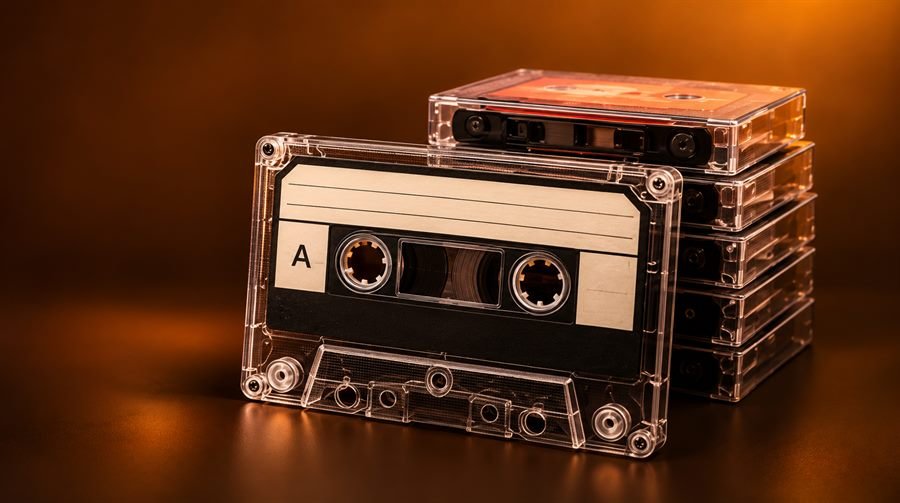
The reels lived inside a sealed plastic shell, so the tape was never threaded, never touched and difficult to damage. You pushed it in and pressed a button.
Philips also licensed the format widely rather than keeping it proprietary. That decision — more than any technical one — is why the cassette became the thing every other manufacturer built for.
How it worked
Two small reels, a length of magnetic tape, and a shell with openings along one edge. Behind those openings sit the erase head, the record/play head, and a capstan and pinch roller that pull the tape past at a constant speed.
The capstan matters more than it looks. The take-up reel changes diameter as it fills, so it cannot set the speed; the capstan does, and the reels merely keep up. A worn pinch roller is the usual reason an old deck plays at the wrong pitch.
Tape moved at 1⅞ inches per second — slow, which is what made long recordings fit and also what made hiss the format's defining problem. Dolby noise reduction was the standard answer.
The golden years
Two things made the cassette dominant. The car, because a cassette tolerated heat and vibration far better than a record could. And the Walkman: Sony launched the TPS-L2 in Japan on 1 July 1979, and music became something that followed you down the street.
The first Walkman had two headphone sockets and a button that let one listener talk to the other over the music — Sony was not yet certain that listening alone in public would be socially acceptable.
Then there was the mixtape. Making one took as long as it took to play, in real time, and every choice was final. That cost is precisely what made it a gift.
Then and now
The CD offered better sound and instant track access, and the cassette faded through the 1990s. Sony continued the TPS-L2 line until the format's decline in the mid-2000s.
Its return is not really about fidelity — by any measurement the cassette loses. It is about the object: cheap to produce in small runs, physical enough to sell at a show, and hand-labelled in a way a download cannot be.
Names that mattered
Listed because of what they did, not as recommendations. Velorex Music did not make any of these.
Did you know?
- The Walkman launched under three different names — Soundabout in the US, Stowaway in the UK, Freestyle in Sweden — before Sony standardised on Walkman.
- The TPS-L2 weighed about 14 ounces and ran on two AA batteries.
- A pencil fits a cassette hub because the hub was designed to be turned by a spindle — winding tape by hand saved batteries.
- Type IV metal tapes needed a deck that could bias for them; using the wrong setting produced a dull, distorted recording.
Remember this?
Recording off the radio meant sitting with a finger over the pause button waiting for the DJ to stop talking. You almost always caught a word of speech at the start, and after enough plays that word became part of the song.
Sources & further reading
- Philips — First Philips cassette recorder, 1963
- Smithsonian NMAH — Sony TPS-L2 "Walkman" cassette player
- Smithsonian Music — The Sony TPS-L2 Walkman
- IEEE ETHW — Walkman
Written from these sources, not copied from them. External links open in a new tab.