



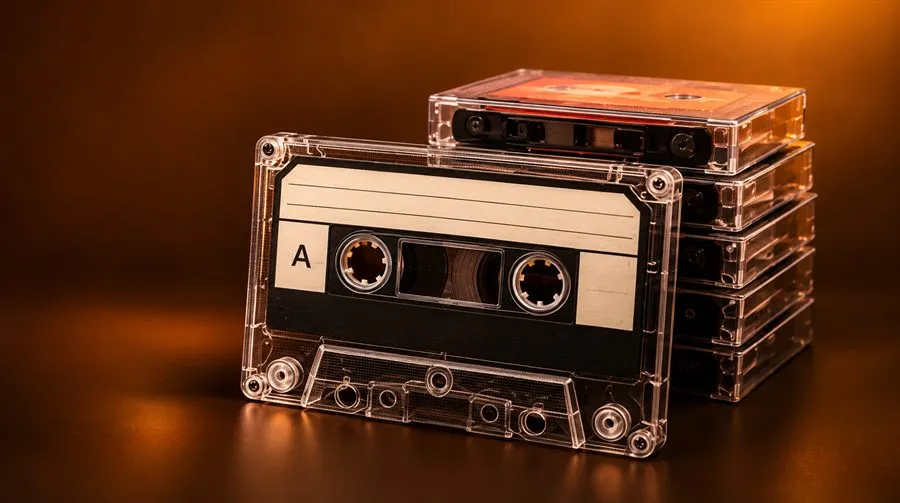










8-Track Cartridges
Mid-1960s onwardsAn 8-track cartridge let a driver insert an album and keep listening without threading a reel or turning a record over. It gave recorded music a practical place on the road.
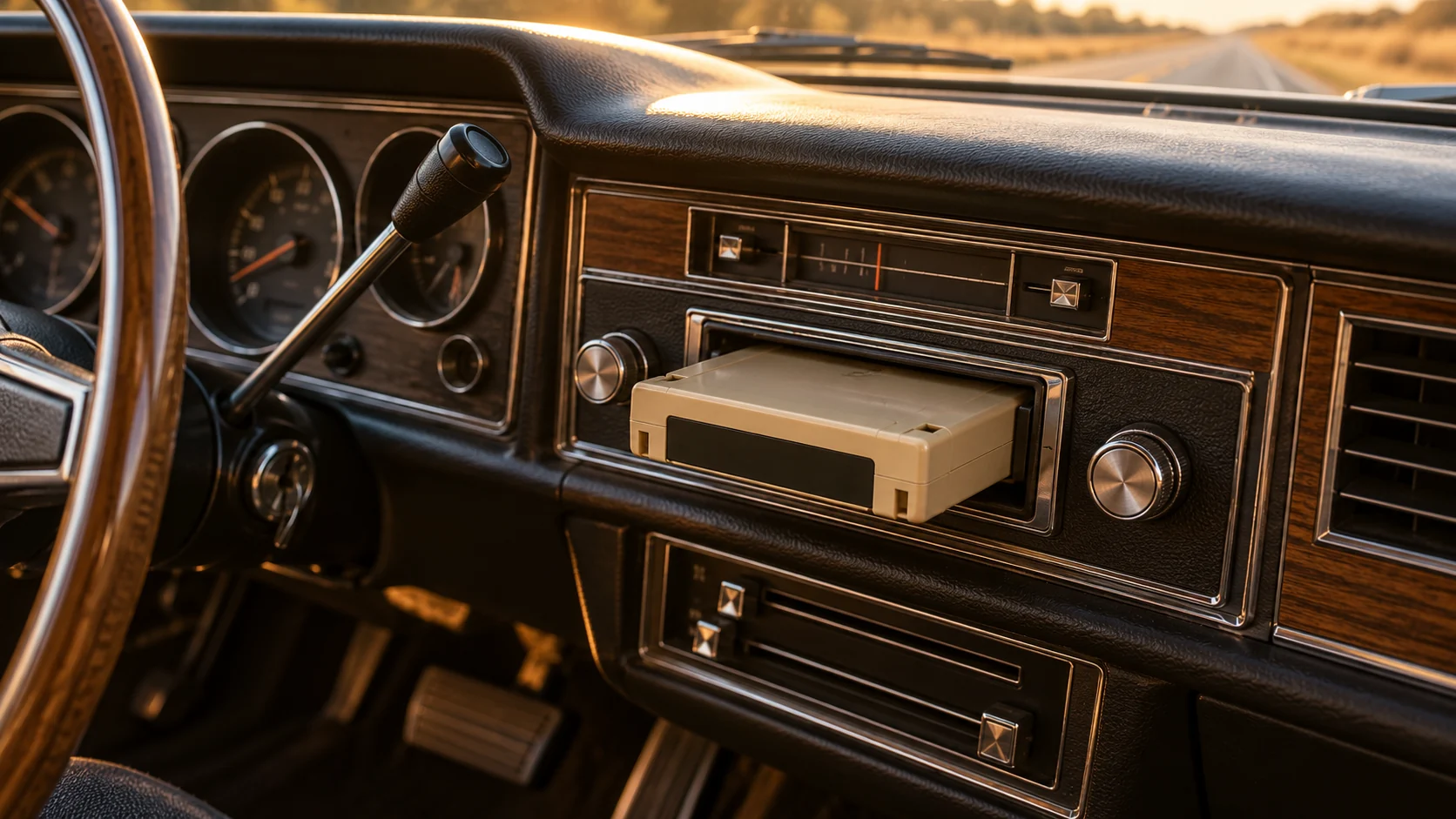
A cartridge for the car
The Henry Ford describes the 8-track as an endless-loop magnetic-tape format developed in the mid-1960s, initially conceived for music in automobiles. A Ford advertisement from 1967 presented an 8-track stereo as a desirable car feature. The cartridge protected the tape and made loading simple enough to do at a dashboard.
It offered longer uninterrupted play than a single record side. That convenience mattered in a moving car, where handling a fragile disc was impractical.
Why eight tracks?
Commercial cartridges generally divided the tape into four stereo programs, each using a pair of tracks. As the loop came around, the player moved its head to the next pair. The Library of Congress cataloguing standard records this four-program, eight-track arrangement.
A song could be interrupted where one program ended. The listener could select a program, but the format did not offer the immediate track selection that later digital media made ordinary.
The cassette takes over
Improved compact cassettes and then CDs displaced 8-tracks in the early 1980s, according to The Henry Ford. The cassette was smaller and could be rewound, while the 8-track remained tied to its bulky continuous-loop design.
Today the cartridge is a reminder that convenience depends on the setting: the same design that felt effortless on a 1970s dashboard became limiting once portable tape players improved.
Names that mattered
Listed because of what they did, not as recommendations. Velorex Music did not make any of these.
Did you know?
- The 8-track cartridge ran as an endless tape loop.
- Commercial cartridges typically held four stereo programs on eight tracks.
- Its first intended setting was the automobile.
Remember this?
The click as the player changed programs was part of the drive — sometimes right in the middle of a song.
Sources & further reading
- The Henry Ford — Boston eight-track cartridge and format overview
- The Henry Ford — Ford Motor Company advertisement, 1967
- Library of Congress — MARC sound-recording tape configuration
- Smithsonian NMAH — Development of tape cartridges
Written from these sources, not copied from them. External links open in a new tab.